1. That day, ten years ago
By my count, it's exactly ten years now.
Ten years ago, Katherine walked into our workshop.
I remember it clearly. The machines were still running. She came in through the door, and nobody stopped sewing — but I looked up from behind my machine and, for a second, I froze.
Our workshop receives clients by the dozen every year. Most come to check progress, inspect samples, review capacity. She came to see how things were actually made.
That was our one and only collaboration with BetterBack.
Ten years later, it is still the only one.
2. Her beauty was the beauty of seriousness
I can still picture her standing at the workbench, head down over a sample.
Hair falling forward, very quiet, fingers turning the pouch corner by corner — checking the stitching, the zipper pull, the inner lining finish. The workshop was loud. She seemed unable to hear any of it.
Some people say a designer's work looks good because the designer looks good. I don't buy that.
Her beauty came from how serious she was. When someone puts all of their attention on one thing, something shows in their face. That light is more striking than anything else.
I understood it later: whatever a person is, that's what their work becomes. She was clean, certain and uncompromising — so the pouch was clean, certain and uncompromising. Not a coincidence.
3. Every process had to pass her eyes
Working on her order was different from the usual.
She didn't want the finished product handed to her. She wanted to see every step in between.
She had to touch the fabric, running her fingers across it to feel the weight and the recovery. She had to work the zipper — back and forth, listening to it, feeling the track. The leather zipper pull she weighed in her hand for a long time. Why leather, not webbing, not plastic? Because your fingers touch it every time you pull — leather feels warmer.
Then sampling. And the first round never passed.
The first version came out and she said no. Change it. The second version: pull it in a little further. Change it again. The third version: she rolled it across the table, then turned it over to inspect the bottom seam.
Change, try, again. Change, try, again.
For a while there was a row of the same pouch sitting on our sample table. To an outsider they looked identical, but only she could point out exactly where version four differed from version five.
Every line, every edge, every corner radius on that pouch today stands on top of several rejected samples.
In all my years doing this, I've rarely met a client who picks at things like that. She wasn't being difficult. She was taking responsibility.
That was when "design" became a different word to me: design isn't the moment you draw it. It's the dozens of revisions after.
4. She never stopped thinking about the person using it
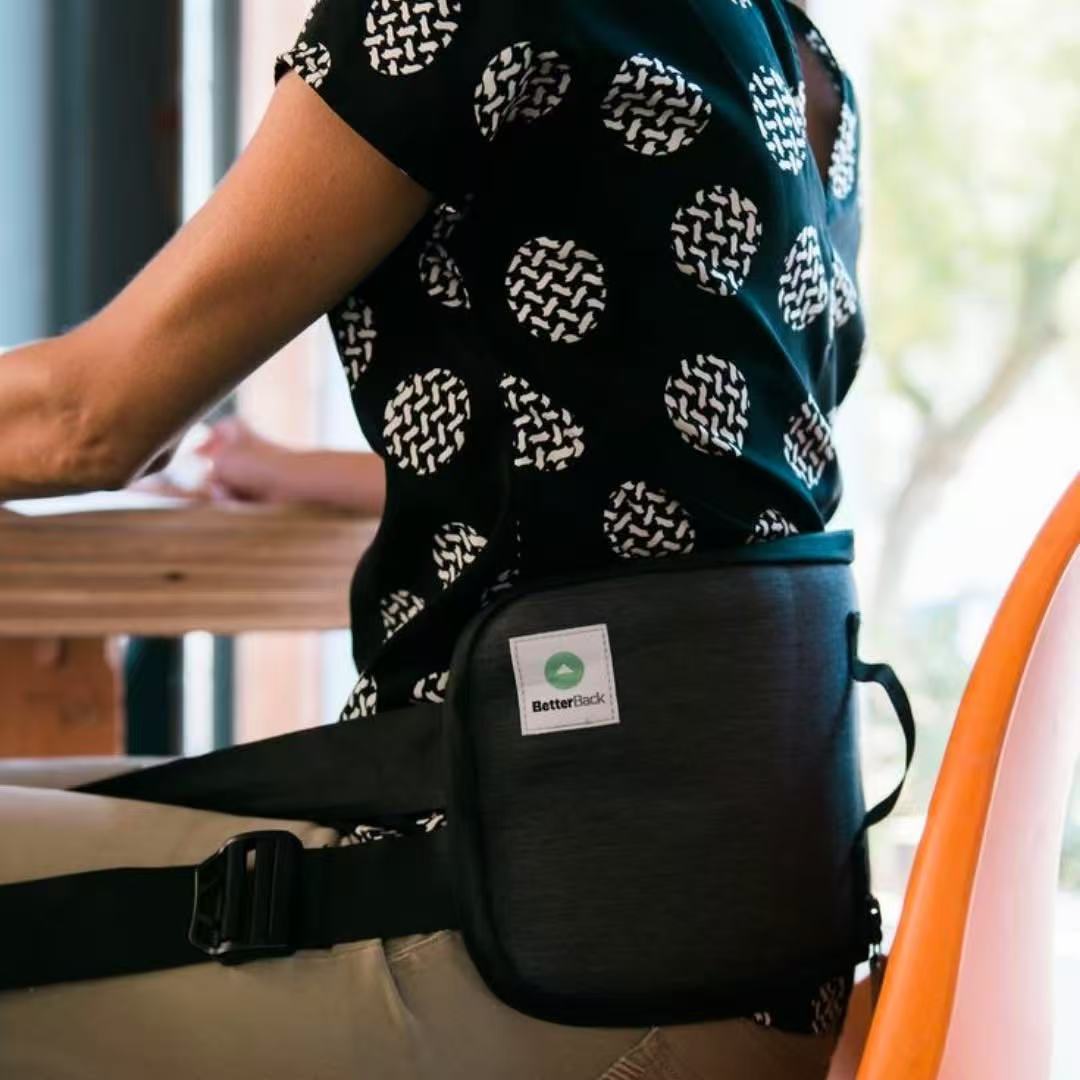
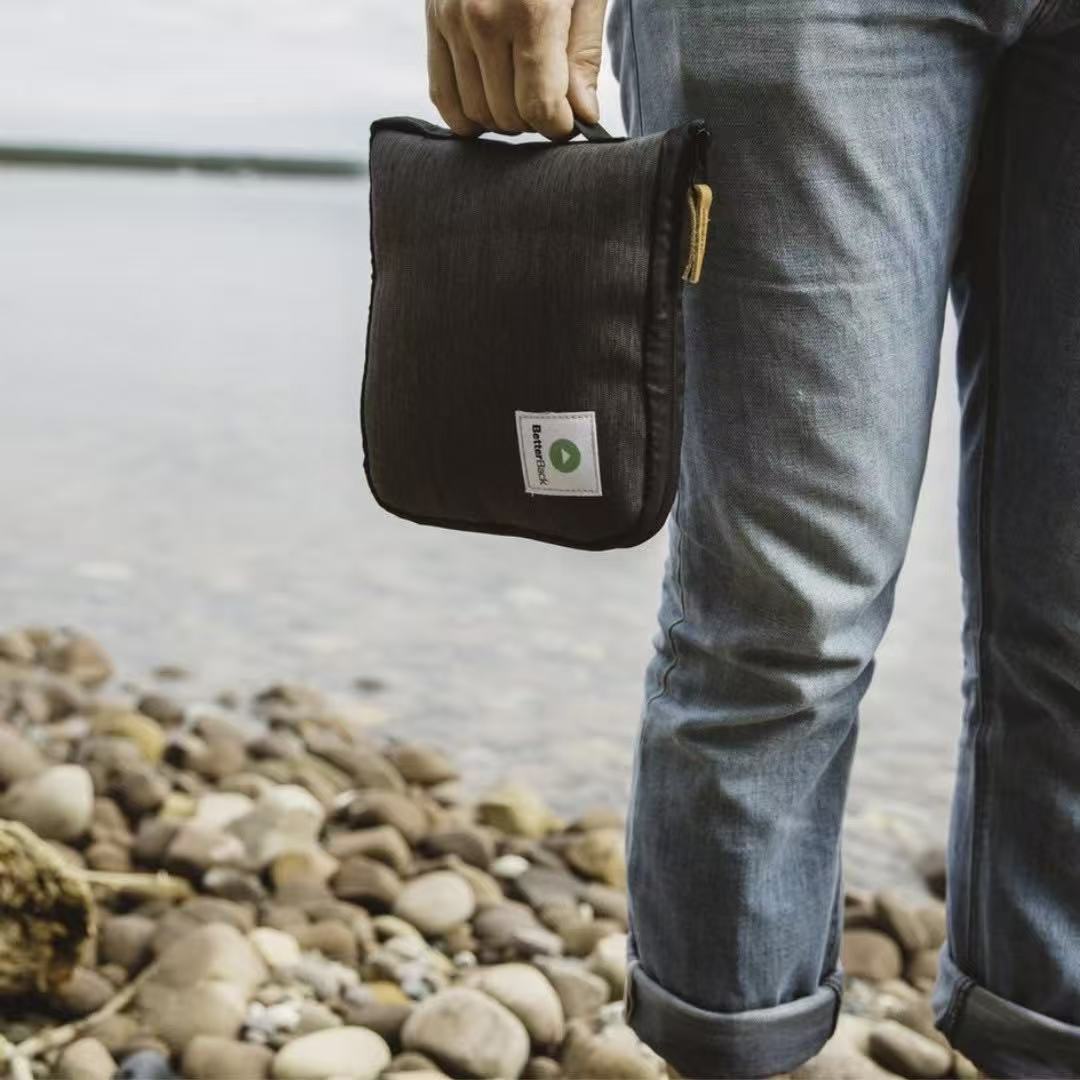
The pouch itself isn't complicated. Dark grey twill, a smooth zipper, a leather pull tab, a white woven label with a green mark on the front.
But that lack of complication is the hardest thing to make.
There's nowhere to hide. In a complicated product you can bury your uncertainty under decoration. In a simple one, all that's left is fabric, stitching, proportion and hand-feel — all of it under the light.
She explained to me where it would live: BetterBack is something you carry with you and use anywhere. It follows its owner to the office, to cafés, on trips. It gets pushed into a duffel bag; it gets dropped into a woman's handbag.
So it had to be small, light, soft, invisible as a tool — and yet never make anyone doubt that it works.
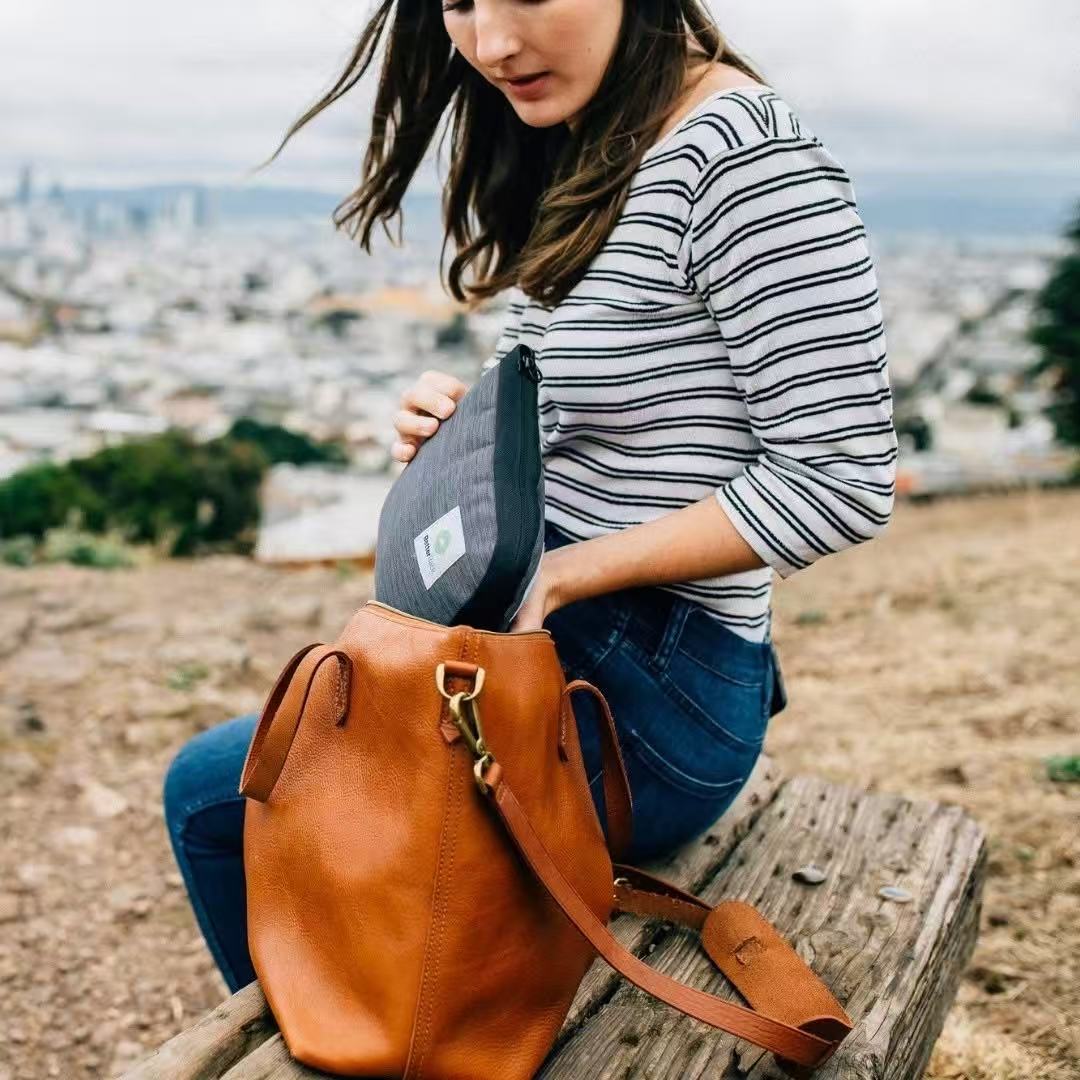
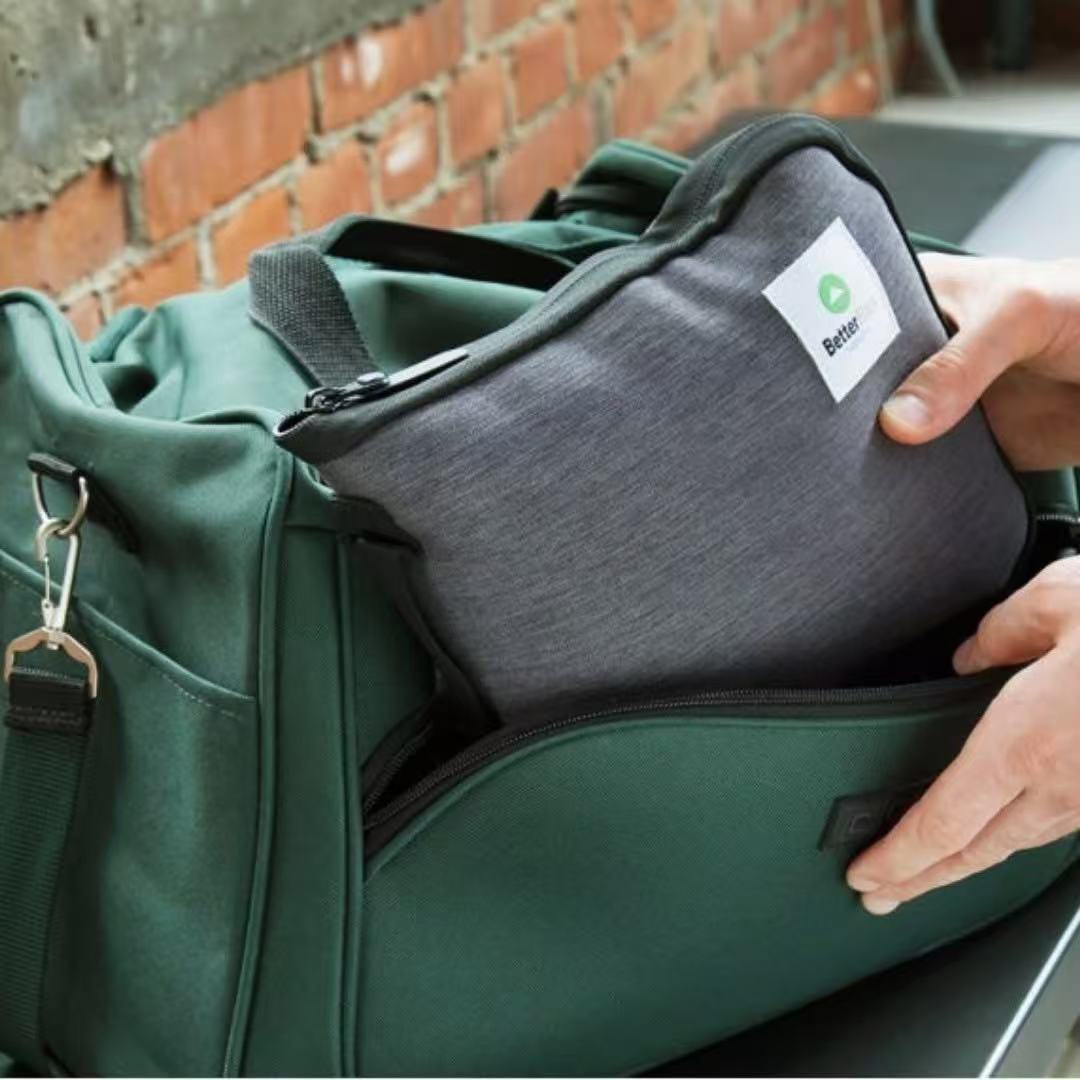
Later I saw the finished photos: a grey pouch going into a dark green duffel bag; the same pouch sliding into a brown leather tote. I felt good about that. Everything she'd described, she'd delivered.
The white woven label reads BetterBack, with a small figure leaning back inside a green circle. The kraft packaging carries a line: "Made possible by you and Kickstarter."
I never forgot that line. A brand that grew out of a crowdfunding campaign is built on the trust of thousands of strangers. Katherine brought that trust into our workshop. She couldn't afford to cut corners. She never considered it.
5. Only once — and I've waited ten years
There was no second time.
The reason was ordinary. No argument, no falling out. That's business: sometimes two lines cross once and then continue on their own paths.
Honestly, I was disappointed for a long time.
I kept asking myself: was something we did not good enough? If we'd pushed a little harder back then, would there have been a next time?
It took a while to settle. Some partnerships aren't about winning or losing — they're about timing, and how long the connection happens to last. But once someone has held you to a real standard, you can't help staying at that level.
Over these ten years we've taken many orders from many clients who came and went. But every time a job requires picking at the details, I think of her. I think of how she turned the pouch over to look at the bottom. I think of her working that zipper again and again.
What she left with us was worth far more than that one order.
Sometimes I wonder what she would see if she walked into the workshop again. She would see straighter stitching than ten years ago, fewer sampling rounds than ten years ago — and that word, "serious," still standing where she left it.
6. If there is ever a next time
I won't hide it: I've been waiting.
Ten years ago I said I hoped there would be a next time. Ten years later I'm saying the same thing — and I'm willing to wait another ten.
Not because we lack orders. Because I'm genuinely curious — what would someone that serious make, ten years on? And I'd love to show her how faithfully we can now bring her ideas to life.
Katherine, if these words ever reach you:
The year you came to our workshop, you did more than you knew. After you left, the way you pressed on craft stayed here and became part of us.
What you taught me wasn't how to make a pouch. It was how to treat something you intend to finish properly.
If there is a next time, I'd take it in a heartbeat.
Even if I have to wait another ten years.